
Where to Watch the Running of the Bulls in Pamplona
The encierro lasts only a few minutes, yet it is one of those events that feels much larger than its duration. The difference between seeing it and truly understanding it often comes down to one simple thing: where you stand.
This guide follows the route from Santo Domingo to the Plaza de Toros, with a closer look at the key sections, the technical facts that shape the morning, and the small details that first-time visitors tend to overlook.
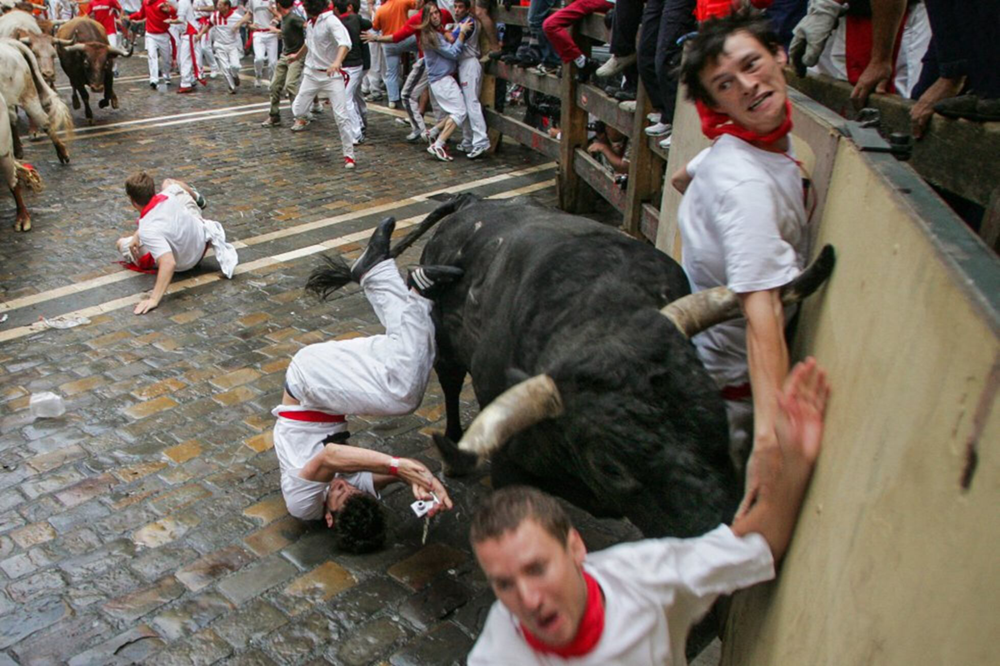
The map matters more than most visitors expect
On a first visit, it is tempting to think of the Running of the Bulls as one single burst of danger. In reality, the route has a distinct internal logic. It descends, opens, bends, stretches, and then resolves itself. Each change of street changes the way the encierro looks and feels.
That is why locals and seasoned visitors rarely speak about “the run” in the abstract. They speak about sections: where the herd is freshest, where the street tightens, where the route becomes easier to read from above, and where the morning begins to make visual sense.
If you want to watch well, begin with the map. It is the quickest way to understand why one balcony, one fence position, or one stretch of the route can give a completely different experience from another.
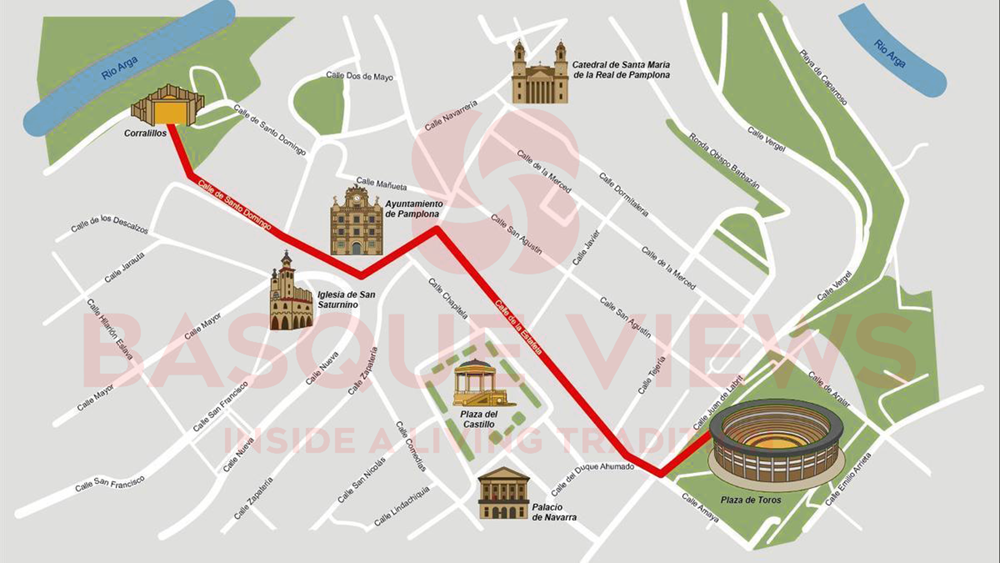
The five points that shape the morning
The clearest way to understand the encierro is to move with it mentally, one section at a time. Each stretch asks something different of the bulls, the runners, and the spectators.
The release
Santo Domingo is where the run begins and where the herd still feels fully charged. The slope gives the opening moments their force, and what you notice first is not elegance but acceleration. It is one of the most intense parts of the route, yet not always the easiest one for a newcomer to read clearly.
A civic crossing
This is a brief but important transition. The route passes through one of Pamplona’s most symbolic urban spaces before folding toward Mercaderes. It is less a climax than a hinge: the point where the city briefly opens and then hands the run back to tighter, more technical streets.
The hinge
Mercaderes changes the logic of the morning. Here the encierro begins to feel tactical. Speed is still there, of course, but angle, line, and anticipation start to matter more. It is the section that prepares the movement into Estafeta and gives the route one of its most charged transitions.
The stretch most visitors remember
Estafeta is where the encierro becomes legible. The street is long enough for the eye to follow the herd properly, and from above it reveals the spacing, the rhythm, and the pressure of the route in a way street level often cannot. For many first-time visitors, this is the moment the run stops feeling abstract and starts making sense.
The close
After Estafeta, the morning begins to resolve itself. The run moves toward the arena and the emotional arc of the route starts to release. By the time the bulls disappear into the Plaza de Toros, the essential story has already unfolded in the streets above.
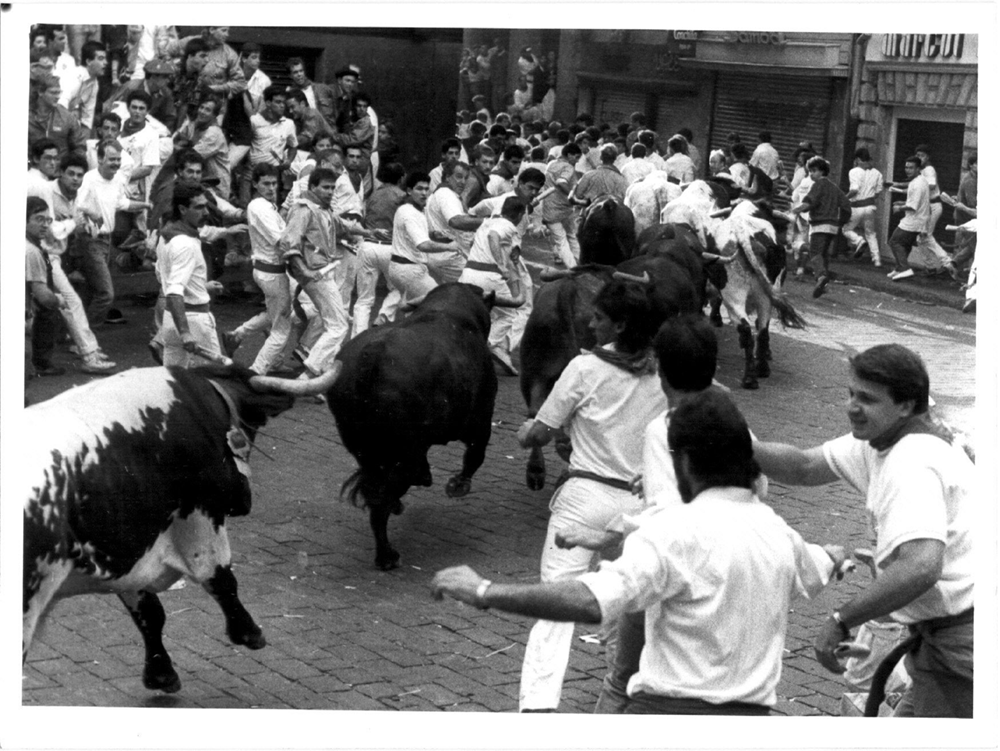
Ayuntamiento is less about spectacle than connection
This stretch does not need to carry the whole narrative of the morning. Its role is subtler than that. Ayuntamiento matters because it links the civic centre of Pamplona to the sharper movement that follows, and because it briefly reminds you that the encierro belongs to a city before it belongs to an image.
Seen that way, the square becomes what it really is within the route: not the star of the story, but one of the pieces that gives the rest of the course its sense of sequence.
Why Estafeta became the enduring image of the run
There is a reason old photographs of Estafeta still feel so immediate. The street compresses almost everything outsiders imagine about Pamplona into a single frame: balconies above old facades, runners searching for space, and a herd moving through a corridor that feels both intimate and exposed.
For a travel writer, Estafeta is the section that explains how San Fermín left the scale of a local festival and entered the wider imagination. For a visitor, it is also one of the clearest places to understand why perspective matters so much.
- One of the longest and most legible sections of the route
- Architecturally central to the visual identity of Pamplona
- Easier to follow from above than the opening slope
- Often the most satisfying stretch for a first-time spectator
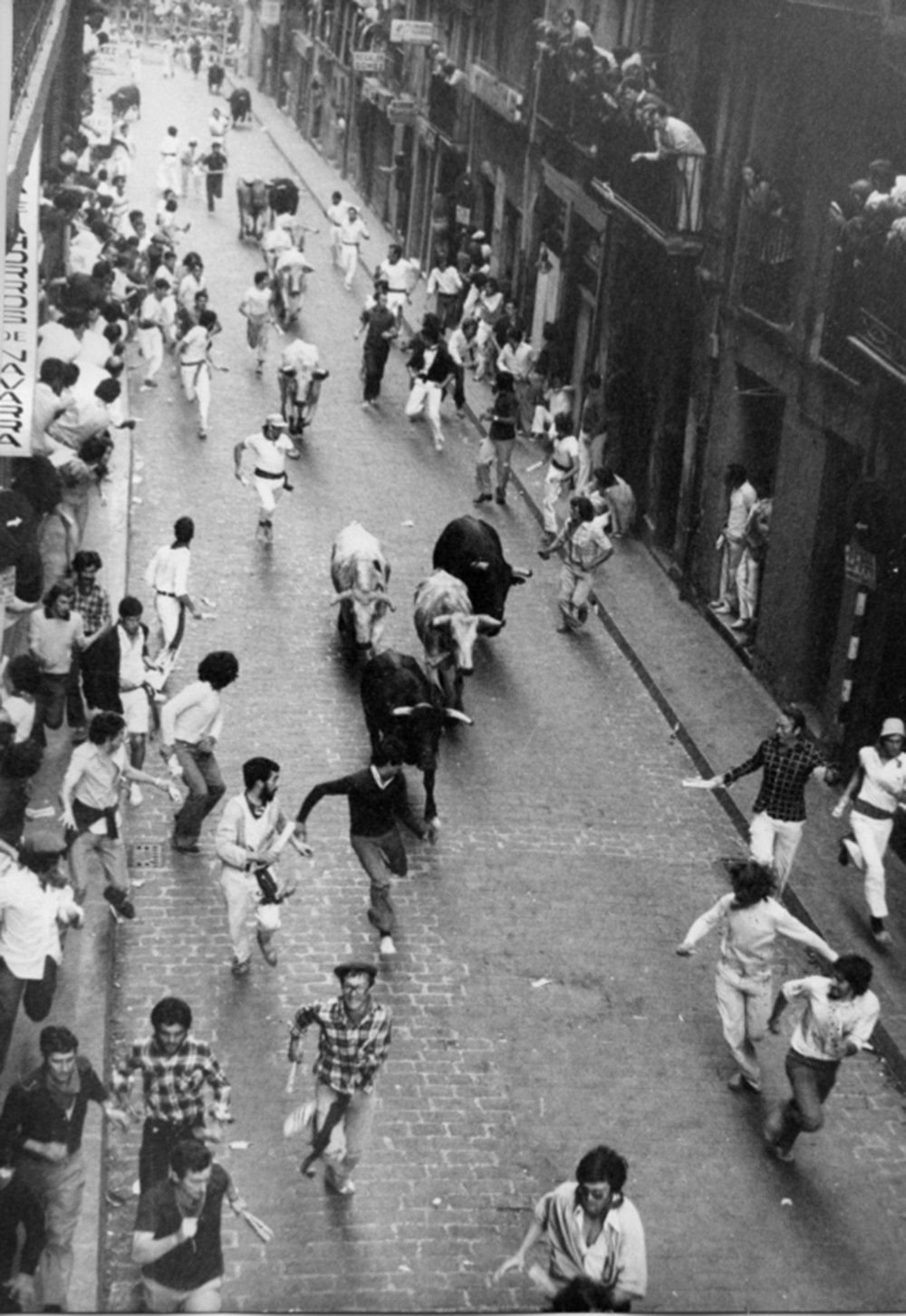
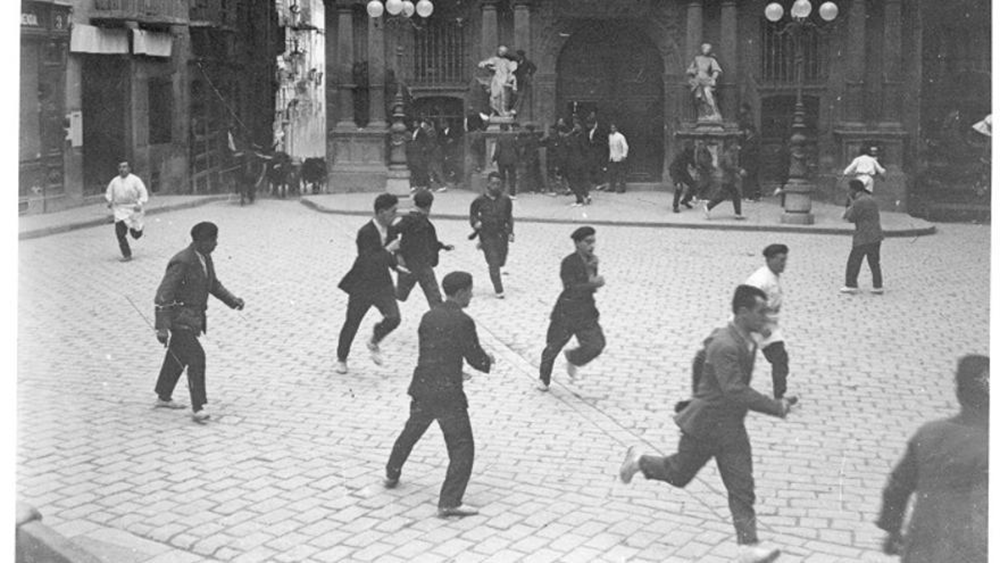
Before barriers, before the crowd we know now
One of the most striking things about older photographs of the encierro is how little they resemble the crowded modern myth. The streets feel barer. The number of runners is smaller. The whole scene appears more open, less managed, and more local in scale.
This contrast restores proportion. San Fermín did not begin as an international show. It grew from a city’s own rhythms, and only later became one of the world’s most recognisable public rituals. The modern barriers, dense crowds and global attention came afterwards.
Seen through this older lens, the encierro feels less like a performance and more like an inherited civic act — which, beneath the spectacle, it still is.
Hemingway and the making of an international myth
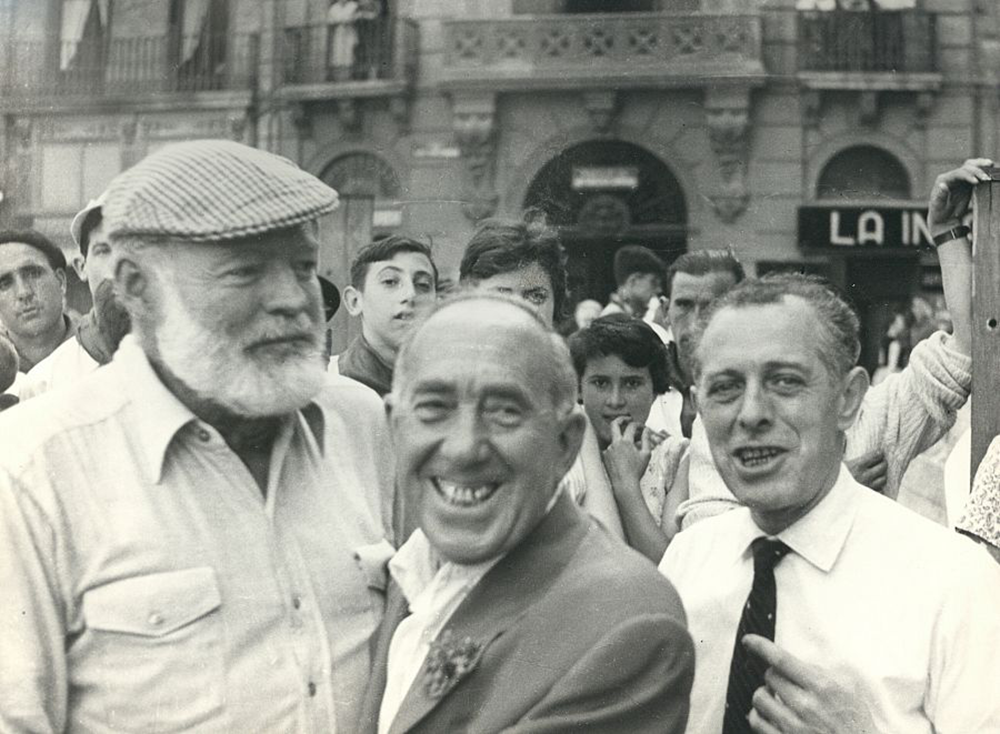
For an American audience, Pamplona is difficult to separate from Hemingway. His early visits to the city, and later the publication of The Sun Also Rises, helped carry San Fermín far beyond Navarre and into a broader literary imagination. Many travellers still arrive with some version of that myth already in mind.
Yet the city itself is more precise than the myth. The most rewarding experience is rarely the loudest one. It is the one that lets the morning reveal its structure, its pace, and its silences. That is where the romance of Pamplona becomes something more durable than spectacle.
Hemingway may have carried the festival outward, but the city still asks to be understood on its own terms.
How to approach it without fantasy
People who know the encierro well tend to repeat the same point: it is not a stunt, and it is not something to improvise. If you are considering running, the wisest first step is to understand that the goal is not to “do the whole route” heroically, but to choose a section, run briefly and cleanly, and know how to leave.
Choose one section
The official rulebook explicitly warns that running the entire course is not realistic. Pick the stretch that suits you best and know your exit before the bulls arrive.
Come sober and light
No phones, no cameras, no bags, and no bravado. Footwear matters, reflexes matter, and sobriety matters even more.
Know the cut-off
Runners cannot enter the course after 7:30 a.m., and on the 7th plus weekends the limit can be earlier. If you are late, you are not running.
The simplest advice is also the best: if you do not fully understand the route and the rules yet, watch first, learn first, and run another year if you still want to. San Fermín rewards respect more than impulse.
So where is the best place to watch?
That depends on what you want to understand. If you want the raw opening energy, Santo Domingo has force. If you want to read the route as a sequence, Estafeta usually offers the clearest experience. If you are interested in the city’s own rhythm and symbolism, the middle sections reveal how architecture shapes the run.
The reason balconies matter is simple: they replace guesswork with perspective. From street level, the encierro can be thrilling but fragmentary. From above, the route becomes readable. You see spacing, direction, hesitation, and speed all at once. For many first-time visitors, that difference is decisive.
A good balcony does not distance you from the event. It gives you a more intelligent way into it.
Keep the guide, then compare the sections
If this page has helped you understand the route more clearly, the practical next move is simply to compare the available balcony sections and see which one best matches the kind of morning you want — whether that is the line of Estafeta, the transition through Mercaderes, or a calmer first encounter with the run.
You can browse the current options here, or write directly if you want help choosing the most suitable stretch.